
A data breach can shut down a small business for days, expose customer records, and trigger regulatory scrutiny, yet most companies in Fredericksburg, VA do not have the budget for a dedicated security team. The good news is that a focused, layered approach built on proven controls can reduce risk sharply without enterprise-level headcount.
This guide breaks down practical, research-backed steps that Fredericksburg businesses can implement now, plus how local IT support fills the gaps when internal resources run thin.
Key takeaways from this article:
- Multifactor authentication blocks the vast majority of automated credential attacks when enforced across all business accounts and services.
- Employee phishing awareness training turns staff from a weak link into an early-warning system, because most breaches still start with a single clicked message.
- Prompt patch management and offline encrypted backups address the two recovery scenarios every small business faces: stopping an exploit and rebuilding after one.
- A written incident response plan, even a basic one, cuts confusion and downtime because decisions made during an attack are almost always worse than decisions made before it.
Why small businesses in Fredericksburg face outsized breach risk
Small and mid-size businesses are attractive targets because they often hold valuable customer and financial data while lacking the defensive depth of larger organizations. Attackers know this imbalance well, and automated scanning tools let them probe thousands of businesses at once for weak credentials or unpatched systems.
The cost of recovery, including legal notification, credit monitoring, system restoration, and lost revenue, can overwhelm a business that operates on thin margins. For many companies in Fredericksburg and surrounding Virginia markets, one serious incident is enough to threaten long-term viability.
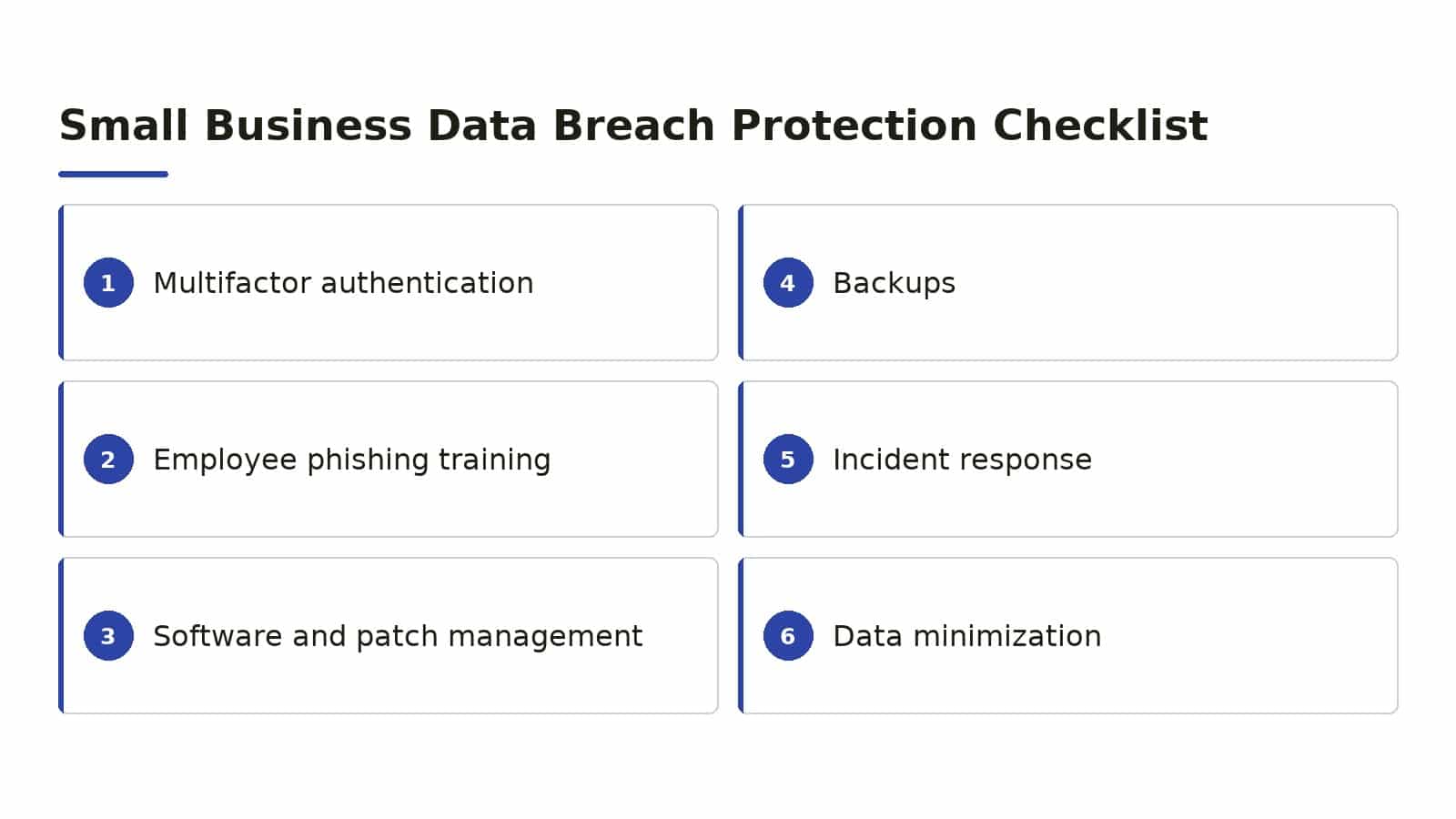
Small Business Data Breach Protection Checklist
- ✓Multifactor authentication: Required for all accounts and services, with priority on email and financial platforms
- ✓Employee phishing training: Train staff to identify and report suspicious messages per federal guidance
- ✓Software and patch management: Promptly install security updates for all internet-facing and internal systems
- ✓Backups: Maintain offline, encrypted copies and test recovery procedures regularly
- ✓Incident response: Maintain and exercise a basic response, resiliency, and communications plan
- ✓Data minimization: Store only data needed for operations and review access permissions periodically
Controls align with CISA guidance for small business cybersecurity.
What the threat landscape looks like for businesses without dedicated security staff
Phishing remains the primary initial access vector for business email compromise and ransomware deployment, according to federal guidance that emphasizes employee reporting as a foundational control. Socially engineered messages have grown more polished, often impersonating vendors, banks, or internal executives with timing tied to real business cycles like invoicing or payroll.
Ransomware and extortion operations have shifted toward smaller targets partly because defenses at large enterprises have hardened, while small businesses often run outdated software and lack offline backup discipline. Exploitation of known vulnerabilities, sometimes months or years after patches were released, continues to account for a significant share of successful breaches.
Layer one: lock down access with multifactor authentication
Passwords alone are no longer adequate protection for business email, banking, cloud storage, or any service that holds sensitive data. Multifactor authentication adds a second verification step, typically a time-based code or hardware key, that stops credential-stuffing and phishing attacks even when the password is compromised.
Businesses should require MFA across all accounts and services, with priority given to email platforms because email compromise is the gateway to invoice fraud, wire transfer theft, and further account takeover. Recovery codes and backup authentication methods should be stored offline and accessible only to designated personnel.
Layer two: train employees to recognize and report phishing attempts
Technology filters catch many malicious messages, but some always reach the inbox, and the employee who recognizes the threat becomes the most important defensive layer. Training should cover current techniques: lookalike domains, urgency-based requests, unexpected attachments, and messages that bypass normal approval channels.
A reporting culture matters as much as the training itself. When staff know how and where to flag suspicious messages without fear of punishment, security teams or IT partners gain early warning that can prevent a single clicked link from becoming a network-wide incident.
Federal guidance identifies phishing awareness and employee reporting as foundational small-business safeguards.

Layer three: keep software patched and systems current
Unpatched software is one of the most reliable paths attackers follow into a business network, and the patches to close those paths are usually already available from the vendor. A disciplined process for testing and deploying security updates, especially for internet-facing systems like email servers, remote access tools, and web applications, closes windows of exposure before they can be exploited.
Patch management is not glamorous work, but it is among the highest-return security investments a small business can make. Keeping business software updated reduces exposure to exploitable vulnerabilities that threat actors scan for and weaponize at scale.
Layer four: maintain offline, encrypted, tested backups
Backups are the last line of defense when prevention fails, but only if they are structured to survive the attack itself. Ransomware operators actively seek and encrypt connected backups, so maintaining an offline or air-gapped copy is essential for recovery without paying a ransom.
Encryption protects backup data from unauthorized access, and regular testing confirms that restoration actually works under pressure. Federal guidance recommends maintaining offline encrypted backups and regularly testing recovery procedures, because a backup that cannot be restored is not a backup at all.

Layer five: reduce data exposure through minimization and access controls
Every record a business retains is a record that can be lost, so storing only data needed for operations limits the potential impact of a breach. This principle applies to customer information, employee files, financial archives, and any historical data kept beyond regulatory or business necessity.
Access controls should follow least-privilege principles: employees see only the data their role requires, and administrative rights are granted sparingly. Periodic reviews of user accounts and permissions catch orphaned access from departed staff or role changes that leave unnecessary privileges in place.
Layer six: prepare a basic incident response plan before you need it
The hours after a suspected breach are chaotic, and decisions made without preparation are usually slower, costlier, and more damaging than those planned in advance. A small business should maintain and exercise an incident-response, resiliency, and communications plan that covers who decides, who acts, who communicates, and how operations continue.
The plan does not need to be lengthy, but it must be current, accessible offline, and practiced at least annually. Key contacts, including IT support, legal counsel, insurance representatives, and relevant regulators, should be listed with current phone numbers and escalation paths.

How Businets Inc helps Fredericksburg businesses close the security gap
Businets Inc is a hands-on team of engineers and technicians who have been keeping Virginia businesses connected since 1995, with a local help desk that answers in minutes rather than days. For Fredericksburg-area companies without a full security team, we provide managed IT services that layer endpoint detection and response, firewall management, and security monitoring onto existing infrastructure.
Our cybersecurity training empowers teams with the knowledge to recognize and respond to threats, while our backup and recovery services include offline encrypted copies with tested restoration procedures. We also implement access control systems, email security, and anti-malware solutions sized for the business, not oversold for enterprise budgets.
Because we are based in Fredericksburg, VA, we understand the local business environment and can respond on-site when remote resolution is not enough. Our team includes network engineers, service managers, and technicians who work directly with client systems rather than routing every issue through a distant call center.
Whether your business needs a complete security overhaul or targeted reinforcement in areas like patch management, MFA rollout, or incident response planning, we build protection that matches actual risk and available resources.
Frequently Asked Questions
What is the most important single step a small business can take to protect from data breach?
Enforcing multifactor authentication across all business accounts, especially email, provides the strongest immediate reduction in risk because it blocks the credential-based attacks that precede most breaches. It is inexpensive, widely supported, and effective even when passwords are stolen or guessed.
How often should a small business test its backup recovery process?
Testing should occur at least quarterly for critical systems, with annual full-scenario drills that include restoration to alternate hardware or cloud instances. Regular testing reveals problems with media degradation, missing encryption keys, or incomplete data sets before an emergency makes them catastrophic.
Can a business with no IT staff still implement these security layers?
Yes, but the business needs a reliable partner to configure, monitor, and maintain the technical controls. A local managed IT provider can deliver the same protective layers that enterprise security teams build internally, scaled to the business size and budget.
What should an incident response plan cover at minimum?
At minimum, the plan should define roles and decision authority, list critical assets and their recovery priority, document communication procedures for staff customers and regulators, and provide contact information for internal and external response resources. It should also specify how to preserve evidence and when to involve law enforcement or legal counsel.
How does employee training reduce breach risk compared to technical tools alone?
Training addresses the human entry point that technical filters cannot fully close, and it builds a reporting culture that turns every employee into a sensor. Organizations with active phishing awareness programs detect and contain incidents faster because suspicious activity is flagged earlier in the attack chain.

About the author
Robert Buongiorne - Owner
Robert Buongiorne is the president of Businets Inc, a Fredericksburg, Virginia IT company he founded in 1994. A lifelong Fredericksburg resident with more than 30 years in IT, he built the business from a one-person operation into a team that has kept Virginia businesses connected since 1995.