
A Remote Access Trojan, or RAT computer threat, is malware that quietly opens a backdoor into your system and lets an attacker control it from anywhere on the internet. Unlike ransomware that announces itself with a locked screen, a RAT hides in the background, logging keystrokes, stealing files, and moving laterally across your network for weeks or months before anyone notices.
Fredericksburg, VA businesses face the same RAT risks as larger metro areas, but often with fewer dedicated security staff and tighter IT budgets. This guide explains how RATs infect local networks, what Virginia and federal standards require for remote access security, and the concrete steps your organization can take to reduce exposure.
Key takeaways from this article:
- A RAT computer infection typically enters through phishing email, compromised remote desktop credentials, or a malicious software download, then establishes persistent command-and-control communication.
- Virginia SEC530 and federal guidance require routing all remote access through authorized control points, hardening remote devices, and deploying multi-layer malicious code protection including trojan detection.
- Application allowlisting, strict RDP limits, and phishing-resistant multifactor authentication are the three most effective technical controls against remote access tool abuse by threat actors.
- Continuous 24/7 monitoring through managed detection and response services helps Fredericksburg businesses catch RAT activity during the dwell time window before data exfiltration occurs.
What a RAT computer threat actually does inside your network
A Remote Access Trojan is a specific category of malware designed to give an attacker administrative control over an infected endpoint. Once installed, the RAT opens a covert communication channel to a command-and-control server, allowing the attacker to execute commands, browse files, activate cameras and microphones, and install additional tools without triggering standard antivirus alerts.
The danger lies in persistence and stealth. A RAT does not damage systems immediately; it gathers intelligence, maps your network, and waits for the right moment to exfiltrate sensitive data or pivot to higher-value targets like domain controllers and financial systems.
RAT Computer Defense Checklist for Fredericksburg Businesses
- ✓Route all remote access through authorized, managed control points: Required: Document remote access rationale in system security plan; route all remote access through authorized and managed network access control points per Virginia SEC530
- ✓Formally authorize users and harden remote access devices: Required: Obtain formal authorization with unique user ID and password before remote access; physically and logically harden all remote access devices
- ✓Prohibit and detect malicious programs including trojan horses: Required: Explicitly prohibit development/propagation of trojans; deploy multi-layer malicious code protection across endpoints and networks
- ✓Audit and allowlist remote access tools, enforce phishing-resistant MFA: Required: Maintain inventory of remote access tools; allowlist only approved software; strictly limit RDP; enforce phishing-resistant MFA for VPNs and critical accounts
- ✓Use up-to-date antivirus and endpoint protection on all remote hosts: Required: Mandate current antivirus/endpoint protection on all remote devices; enforce secure VPN use and strong passphrases
- ✓Engage local MDR/XDR services for 24/7 RAT monitoring: Recommended: Partner with Fredericksburg-based MDR/XDR providers for continuous endpoint and network monitoring with rapid threat isolation
Virginia SEC530 and CISA guidance form the foundation of this checklist. Businets Inc provides local implementation support for Fredericksburg, VA businesses.

Common infection vectors targeting Virginia small and mid-size businesses
Phishing remains the dominant delivery method for RAT payloads. An employee receives an email with a malicious attachment or a link to a compromised website, and the trojan installs silently when the file opens or the browser exploits a vulnerability.
Compromised remote desktop protocol credentials are another frequent entry point. Attackers scan the internet for exposed RDP ports, then use brute-force or purchased credential lists to gain access and manually deploy a RAT.
Software supply chain attacks and fake software updates have also delivered RATs to business networks. A user searching for a legitimate utility may download a trojanized version from a lookalike site, granting attackers immediate access.

Virginia SEC530 requirements for remote access security
Virginia Information Security Standard SEC530 establishes binding requirements for organizations that allow remote access to state information systems. The standard mandates that all remote access be routed through authorized and managed network access control points, with the remote access rationale documented in the system security plan.
Organizations must obtain formal authorization before granting remote access capabilities, and each user must receive a unique user ID and password. Physical and logical hardening of all remote access devices is also required, ensuring that laptops, tablets, and home workstations meet the same security baseline as internal equipment.
SEC530 further instructs agencies and their service providers to prohibit users from developing or propagating malicious programs including viruses, worms, spyware, keystroke loggers, phishing software, and Trojan horses. Multi-layer malicious code protection must be deployed across endpoints and networks to detect and block these threats.
Federal guidance on preventing remote access tool abuse
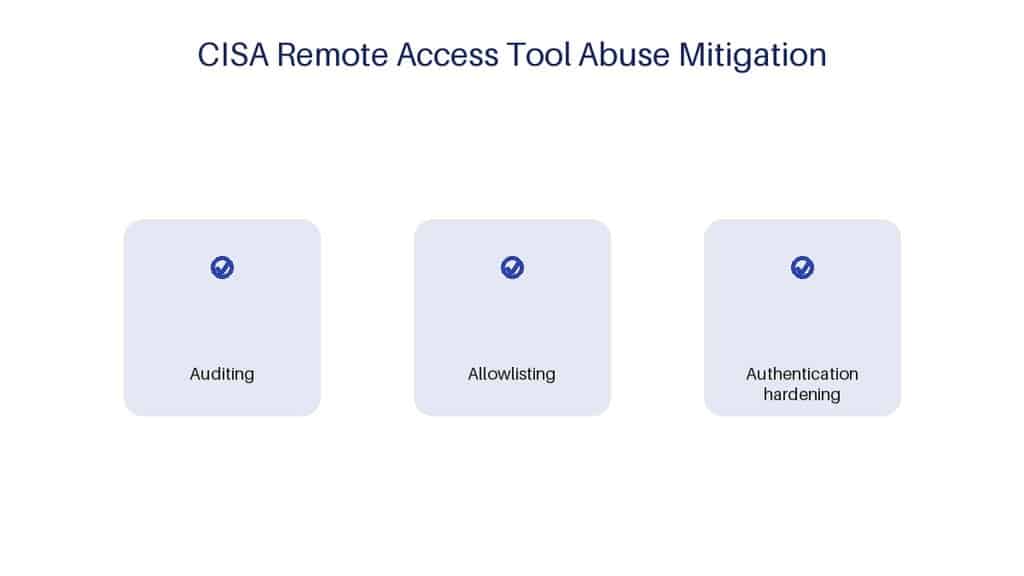
The Cybersecurity and Infrastructure Security Agency has published detailed guidance on mitigating remote access tool abuse, which threat actors increasingly use to establish and maintain RAT persistence. The recommendations center on three operational practices: auditing, allowlisting, and authentication hardening.
Organizations should maintain a complete inventory of remote access tools and allowlist only approved software, blocking unauthorized remote administration utilities that attackers favor. Strict limits on RDP exposure, including network-level authentication and gateway enforcement, close the most commonly exploited vector.
Phishing-resistant multifactor authentication must be enforced for all VPN access and critical accounts. Hardware security keys or certificate-based authentication significantly outperform SMS or app-based codes, which can be intercepted or bypassed through social engineering.
Endpoint protection and remote host hardening essentials
Every remote host connecting to internal networks must run current antivirus and endpoint protection software with up-to-date threat signatures and behavioral detection capabilities. Virginia remote access policy examples explicitly require this baseline, and organizations that skip it create an easy foothold for RAT installation.
Organizations seeking a proactive way to validate their defenses against RATs and other hidden threats should consider Penetration Testing Fredericksburg VA to identify exploitable weaknesses before attackers do.
Secure VPN use and strong passphrases round out the host-level controls. Split tunneling should be disabled so all traffic routes through the corporate security stack, and passphrases should be lengthy, unique, and stored in a reputable password manager rather than browser autofill or sticky notes.
How Businets Inc helps Fredericksburg businesses monitor for RAT activity
Businets Inc is a hands-on team of engineers and technicians who have been keeping Virginia businesses connected since 1995. Based in Fredericksburg, VA, the company provides managed IT services, cybersecurity solutions, and 24/7 monitoring through managed extended detection and response and endpoint detection and response capabilities.
The local help desk answers in minutes, not days, which matters when a potential RAT indicator surfaces outside normal business hours. Businets Inc offers cybersecurity training to help teams recognize phishing and social engineering, plus security services including firewalls, anti-virus and malware protection, and digital video surveillance systems.
For organizations that need continuous threat monitoring without building an internal security operations center, Businets Inc delivers flat-rate IT support with rapid escalation and threat isolation. The team includes Robert Buongiorne, President; Walter Scott, Network Engineer and Partner; Stephen Tate, Service Manager and Network Engineer; and technicians who understand the specific compliance and operational pressures facing Fredericksburg-area businesses.
Incident response planning when a RAT computer breach is suspected
Every Fredericksburg business needs a written incident response plan specifically addressing remote access trojan scenarios before detection occurs. Speed matters enormously once adversaries establish persistent access through a compromised endpoint.
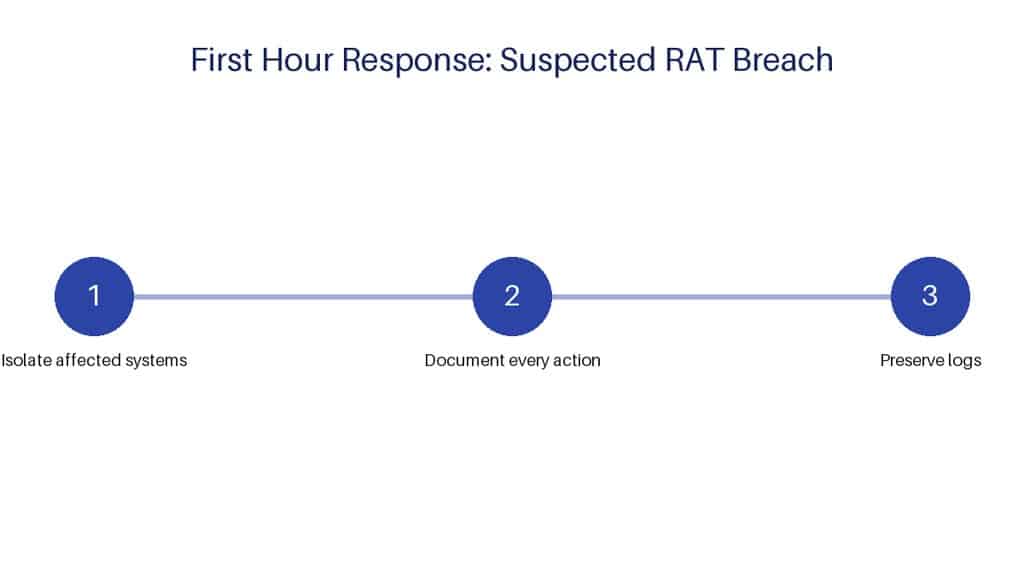
Isolate affected systems immediately without powering them off, since live memory analysis preserves critical forensic evidence. Your IT team or managed security partner should document every action taken during the first hour of discovery.
Preserve logs from firewalls, VPN concentrators, and endpoint detection platforms covering at least seventy-two hours prior to alert. These artifacts reveal lateral movement patterns and command-and-control communication timestamps that guide containment decisions.
Notify your cyber insurance carrier within the policy-mandated window, typically twenty-four to seventy-two hours from discovery. Failure to meet reporting deadlines can void coverage for subsequent remediation costs.
Engage qualified digital forensics specialists who understand Virginia evidence handling standards if sensitive data exfiltration is suspected. Local firms familiar with Fredericksburg’s business landscape often coordinate more effectively with law enforcement and regulators.
Conduct a thorough post-incident review within thirty days to identify detection gaps and strengthen remote access controls. Update your incident response playbook based on lessons learned, then schedule tabletop exercises to validate improvements quarterly.
Frequently Asked Questions
What is the difference between a RAT and regular malware?
A RAT computer threat is specifically designed to give an attacker remote interactive control over an infected system. Regular malware may simply delete files, display ads, or encrypt data for ransom, but a RAT establishes a persistent backdoor that lets the attacker browse files, log keystrokes, and move across your network undetected for extended periods.
How can I tell if a RAT is already on my network?
Signs of a RAT infection include unusual outbound network traffic to unknown IP addresses, unexpected mouse cursor movement, applications opening or closing without user action, and antivirus or endpoint protection tools being disabled. Because RATs are built to evade detection, many infections show no obvious symptoms until data exfiltration or lateral movement triggers other security alerts.
Does Virginia law require specific remote access security measures?
Virginia SEC530 requires organizations to route all remote access through authorized and managed network access control points, document remote access rationale in the system security plan, obtain formal user authorization with unique credentials, harden remote devices, and deploy multi-layer malicious code protection. These requirements apply to state information systems and provide a framework that private businesses in Fredericksburg can adopt voluntarily to strengthen their own security posture.
What makes multifactor authentication ‘phishing-resistant’?
Phishing-resistant MFA uses cryptographic verification that cannot be intercepted or replayed by an attacker. Hardware security keys and certificate-based authentication meet this standard because they prove possession of a physical device or cryptographic credential.
SMS codes and push notifications do not qualify, as attackers can steal or trick users into approving fraudulent requests through social engineering.
Why is 24/7 monitoring important for RAT detection?
RATs often establish command-and-control communication during nights and weekends when IT staff are offline and network traffic baselines are harder to distinguish. Continuous monitoring through managed detection and response services captures anomalous activity during these windows and enables faster containment before the attacker completes reconnaissance or exfiltration.
Should a Fredericksburg business shut down servers immediately upon discovering a RAT?
No. Sudden shutdowns destroy volatile memory evidence that forensic analysts need to map attacker behavior.
Instead, disconnect systems from networks while keeping them powered on, then contact your incident response team or Businets Inc for guided containment.

About the author
Robert Buongiorne - Owner
Robert Buongiorne is the president of Businets Inc, a Fredericksburg, Virginia IT company he founded in 1994. A lifelong Fredericksburg resident with more than 30 years in IT, he built the business from a one-person operation into a team that has kept Virginia businesses connected since 1995.